Slowing Down for Savings
 You may have already taken a peek at our Footprint Chronicles. We launched it a couple of weeks ago and put an announcement up here on TCL. The Footprint Chronicles is a window of sorts. We’re hoping that through it, our customers can see how we’re analyzing our environmental and social impacts and what we’re doing to make improvements.
But that’s on a business level. The relationship Patagonia’s employees have with the Footprint Chronicles has something like a chicken-or-the-egg quality. This project was conceived by folks who don’t often make decisions without considering the environmental impacts. Yet the Chronicles have made one thing quite clear: our individual decisions have environmental impacts far beyond any we might have imagined.
www.ecofoot.org offers an online survey that helps folks figure the metaphorical size of their individual environmental impact. Some of my friends took it and scored in the "5 Earths" range; meaning 5 Earth’s worth of resources would be necessary to support a global lifestyle like theirs. I patted myself on the back for scoring a "3 Earths." But then–on the same day we launched the Footprint Chronicles–I went and bought a really, really big truck.
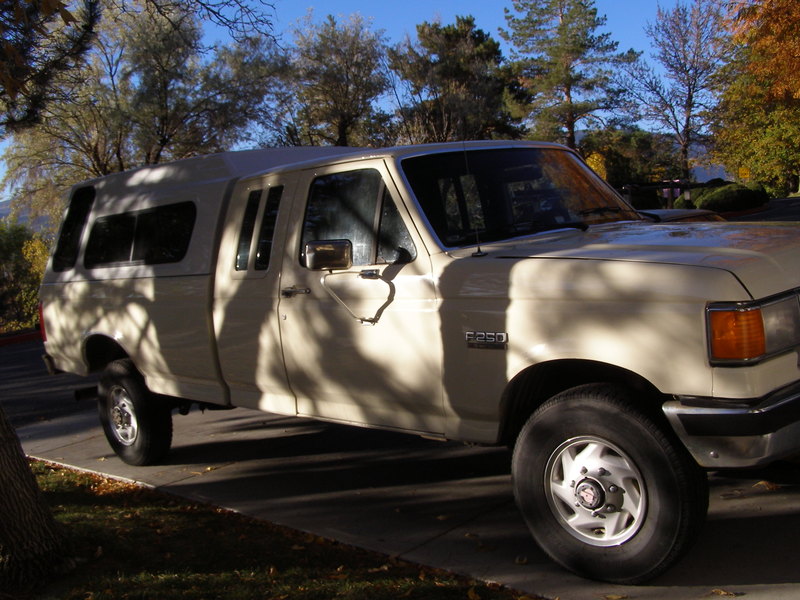 This thing could tow five Earths, not to mention give a hearty boost to my eco-footprint score. This thing’s huge. It’s a monster. A gas-gulping behemoth thirsty for a direct tap into a big, steamy cup of Pre-Cambrian Texas tea.
So why buy it? The list of personal reasons are long, but economics and impact were the prime considerations. Economically, it was far more affordable for me to purchase a used truck, and it was a larger-scale opportunity to Reduce-Reuse-Recycle. Of course gas mileage is terrible in this thing. But when I learned my 20-year-old model actually earned 3 MORE mpg than a friend’s much newer (2 years old) model, it was a no brainer. Why buy a new truck that gets worse mileage, and convinces Detroit to continue producing brand-new inefficient behemoths? We’ve already got more than enough of those to go around.
Far more than my regular commuter vehicle (a bike) this truck has got me thinking about gas mileage. Which is where all of us come in. The 55 mph speed limit that’s so often easy to ignore was put in place for a reason, and it wasn’t to guarantee good ticket revenues for Highway Patrol. Federally mandated speed limits were instituted at a time when America was a bit more sensitive to petrol prices and politicians were a bit more vulnerable to unexpected spasms of common sense. Some smart folks realized this simple–and quite convenient–truth: you save gas and money if you drive slower.
Another friend of mine who’s far better at math sent me some cool information from Wikipedia. He wanted me to be able to calculate just how much extra gas I would be using. I reviewed the equation and noticed quickly that the guilt variable was absent. I did the math and then realized where it came in . . . ouch! Right at the end. It’s hard to admit it here, but I’m gonna do it. That "new" truck of mine is getting a crippling, shameful, downright awful 12 mpg. My gut and wallet have been arguing ever since over which is taking the bigger hit.
Let’s retreat to the cold comfort of equations for the time being. Here’s the equation and gist of what my friend sent me:
In the equation for power to overcome drag (below) velocity is a cubedfunction (v3).
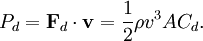
What does this mean? It means that if youdouble your speed, your drag increases 8 times. Or, as explained by wikipedia:
A car cruising on a highway at 50 mph (80 km/h) may require only 10 horsepower(7.5 kW) to overcome air drag, but that same car at 100 mph (160 km/h)requires 80 hp (60 kW). With a doubling of speed the drag (force)quadruples per the formula. Exerting four times the force over a fixeddistance produces four times as much work. At twice the speed the work (resulting in displacement over a fixed distance) is done twice as fast. Since power is the rate of doing work, four times the work done in half the time requires eight times the power.
For more detail than most lay-persons need on this topic, check out the Wikipedia article on Automobile Drag Coefficients.
For more money in your pocket, a lighter step on the throttle–and the planet–really adds up.
[Once bitten, twice shy . . . Great White is now beached in my driveway. Photo: localcrew]


